Buse İlkin Yerli
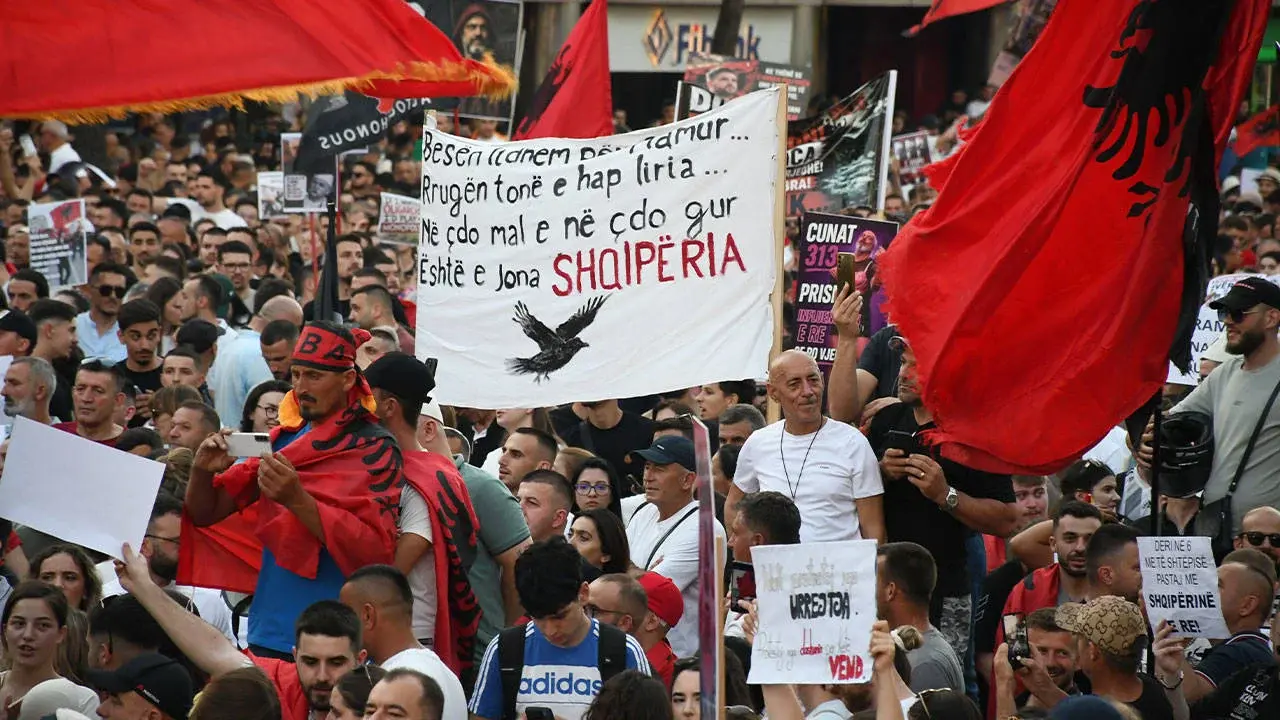
Thousands have been on the streets in Albania for days. The plan to open the Narta Lagoon, one of the country's most important natural areas, and Sazan Island, known for its strategic location in the Adriatic Sea, to billion-dollar tourism projects linked to Donald Trump’s son-in-law Jared Kushner’s investment fund has ceased to be just an environmental debate.
People are raising their voices in protest against the handover of public spaces to private interests, the opening up of protected ecosystems to development, corruption, and the system established by the political elite.
Even though the project has been cancelled, the anger continues. We spoke about this growing objection in Albania with John Merko, who is involved in the demonstrations.
THEY HAVE BEEN DECEIVING THE PUBLIC FOR 20 YEARS
What was the breaking point that drove you to take to the streets?
This project is not a simple matter because it irreversibly affects Narta and the region's biodiversity. Furthermore, the project was developed based on legal amendments that made it possible, despite contradicting our obligations under Chapter 27 on the environment, which we must comply with for European Union membership. For more than 20 years, we have listened to the narrative that everything being done is for the purpose of joining the European Union (EU), and now this goal is being toyed with. The day we all took to the streets was 30 May. On that day, barbed wire was erected in Narta, and private security guards dragged a local resident away.
What is the fundamental demand of the demonstrations?
As a first step, we demand the cancellation of this project and the repeal of the laws that made it possible. We also want the prime minister to resign. However, our call is no longer directed solely at Prime Minister Edi Rama, but also at the opposition leader Sali Berisha. Together, we are saying, "Rama to prison, Berisha to prison."
How do the government and law enforcement approach the demonstrations? What kind of pressure or obstacles do the protesters face?
Just two days before the public found out that the Narta region had been surrounded by barbed wire, the mainstream media suddenly brought reports about hormone therapies for transgender individuals to the centre of the agenda. In Albania, the LGBTI+ community is historically a scapegoat used to overshadow political agendas. Although some laws regarding LGBTI+ rights were drafted to facilitate the EU accession process, these have not found strong support in society. Conservative circles even say they would rather give up EU membership than accept LGBTI+ rights.
However, this time, the distraction efforts did not work. As soon as the Narta scandal came to light, people ignored the headlines and took to the streets. On the third day, we saw some militants close to the Democratic Party trying to pull the protests solely onto an anti-Rama line.
Is this issue just an environmental problem for you, a democracy issue, an economic matter, or a combination of all three?
I think it is a combination of the three. However, the environmental dimension is the most critical. Because the matter does not only affect flamingos; it affects many living species residing in the region. Our aim is not to create the impression that Albania is closed to international investments. But these investments must comply with the laws. According to current legislation, any project to be carried out in this region must have a minimal impact on biodiversity.
THE COUNTRY IS SHAKEN BY CHEAP LABOUR AND CORRUPTION
What other accumulated grievances in the country did the reaction against the allocation of lands to imperialist capital make visible?
There are many foreign companies operating in Albania; the country is seen as a source of cheap labour. The minimum wage is quite low; around 40 thousand leks (approximately 22,500 Turkish Liras). This situation is a modern form of exploitation. People now refuses to work for these wages. As a result, workers are brought in from poorer countries like India and the Philippines, and they receive the minimum wage in return for working 40 hours a week.
Alongside this, the Belinda Balluku file is one of the biggest corruption scandals currently on the agenda in Albania. She stands accused of committing irregularities in various public tenders, including sections of the Llogara Tunnel and the Tirana Ring Road. After she left office, the Special Anti-Corruption and Organised Crime Structure (SPAK) requested the lifting of her immunity so that she could be arrested. However, the majority of the ruling Socialist Party voted against it. Therefore, she is still free as an MP. She only has a ban on travelling abroad.
We had not seen protests of this scale in Albania for a long time. What do you think is different today?
These protests are being organised by Gen Z, and they are the ones making the difference. Their approach to the media and political parties is very different. The network of solidarity and resistance they have formed makes it difficult for any political party to divide them. They do not just want the prime minister to resign; they also demand that the leader of the opposition go to prison.
Anyone can participate in the protests, but we do not allow the focus to be lost. If necessary, we form a wall and ask those who come with different agendas to leave their banners behind. It might be hard to believe, but there are special areas reserved for children at the protests; children spend time here while their parents demonstrate. Most of the participants belong to Gen Y and Gen Z. These two generations share a common dilemma: to stay in Albania or to apply for a visa for a better life... Previous experiences help us build a stronger solidarity network today. We are two generations born after the fall of the dictatorship, and we actually have much more in common than we think.
If the government does not take a step back, what will be the next stage of the protests?
For now, participation is increasing steadily. We do not have a leader; we have our rules and our demands.
Do you think this movement can create a permanent change in Albanian politics?
The message being delivered is very clear: we will no longer remain silent and we will speak on behalf of everyone. We are no longer against each other; we are against the system that divides us. Why do I say this? Because alongside environmentalists, LGBTI+ individuals are also asking the same questions and do not hesitate to stand side by side with people who hold different views. We are meeting on a common ground regarding this. Therefore, even though it is early, something positive has already emerged.
Do you agree with these protests being described in the international public opinion as "protests against the Trump family"? Is the matter really just about that?
I do not think this is solely about Trump. This approach personalises the matter too much. I see this as a struggle against ultra-rich people who think that because they have money, they can buy whatever they want and break the rules.
We have also seen support demonstrations in Greece and Italy. How does this solidarity make you feel? Do you think this struggle could spread to a wider geography?
As these protests grew, the connection with the Trump family became more visible. However, in general, this solidarity makes us happy and strengthens us. It creates the feeling that we are all waging the same struggle.
What would you like to say to people watching you from outside Albania today?
Many Albanians returned to the country from abroad for these protests. However, most of the time, they are discussing other political issues. These issues are important, of course, but now is not their time. The subjects we need to focus on today are Narta, justice, the protection of biodiversity, and, of course, sovereignty.
Note: This article is translated from the original article titled Bizi ayıran sistemle mücadele ediyoruz, published in BirGün newspaper on June 12, 2026.